
This One Is Just for Fun
 Given the nature of what we do, it’s no surprise that everyone at Dobies Health Marketing has at least two personality traits in common: our penchants for creativity and our competitive spirits.
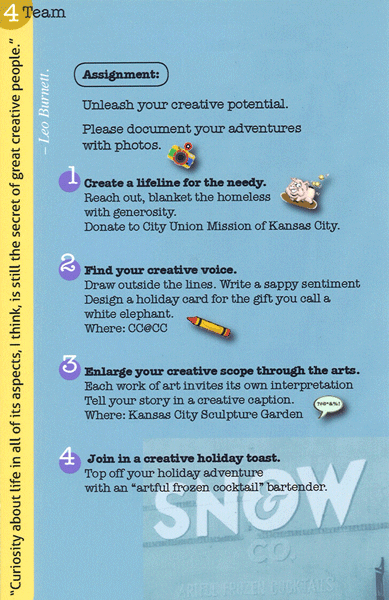
Both factored in during our fourth annual holiday scavenger hunt earlier this month, when we took half a day to “unleash our creative potential” – something we do at work every day, but this time we took it to the streets of Kansas City. Together with our associates at Group 3 Solutions, we ventured out in teams, each one armed with a camera, a charitable donation, and a healthy determination to have fun and finish first.
- Task 1: Find your creative voice. To prepare the final touches for our annual white elephant gift exchange, team members were asked to create holiday cards with “sappy sentiments” and original artwork. It’s always fun to see the range of directions we take with an assignment like this, especially when we’re given crayons and construction paper as our art tools. Nothing helps ring in holiday cheer quite like the festive decor of Hallmark, so we tapped the talents of our inner children at “CC@CC” – the Crayola Cafe at Crown Center.
- Task 2: Create a lifeline for those in need. At Dobies Health Marketing, we believe it’s important to give back to the community all year long. But this time of year – when cold and loneliness have greater repercussions on the health and well-being of the less fortunate in our area – we like to create a special event for it. Teams were sent to Project Warmth KC headquarters and City Union Mission to drop off blankets and monetary donations. Although it may not provoke as many laughs, this is always our favorite part of the scavenger hunt.
- Task 3: Explore the creative vision of an architectural icon. While some of us admired “the old” at the Nelson-Atkins Museum of Art, others marveled at “the new” – the Kauffman Center for the Performing Arts. The latter recently changed our downtown skyline, and both buildings helped put Kansas City on Frommer’s Top 10 Destinations in 2012.
- Task 4: Join in a creative holiday toast. It’s fun to break away into teams at the start, but it’s even more fun to come back together as a group for the end. To show our support for local small business, we capped off the festivities with some “artful frozen cocktails” and Snow & Co. in the Kansas City Crossroads District.
As always when we’re having a blast, time flew by and soon the day was done. Funny…the same thing happens every day at the office, too – just goes to show how much we love what we do here at Dobies Health Marketing.
To view pictures from our scavenger hunt and more, visit us on facebook. Happy Holidays!